How often does a horse need the farrier? Trim and shoe schedules
Most horses need a trim or shoe reset every 6 to 8 weeks, longer in winter. Barefoot vs. shod schedules, signs a horse is overdue and typical US costs.
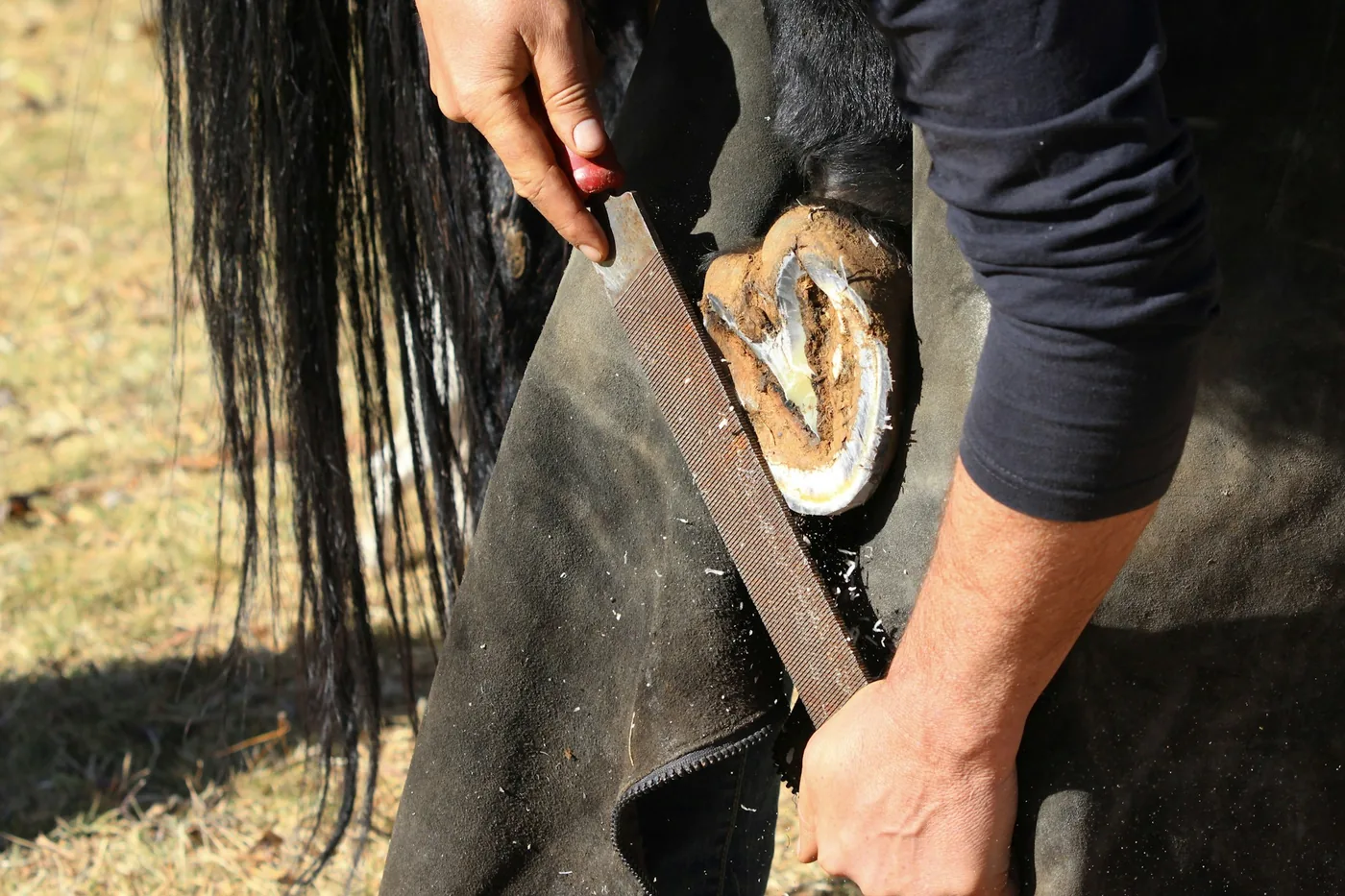
Most horses need the farrier every 6 to 8 weeks, barefoot or shod. In winter, when hooves grow more slowly, many can go 6 to 12 weeks. Barefoot horses in light work can sometimes go 10 to 12 weeks. Horses in shoes, foals and horses with hoof problems usually need the shorter end. Your farrier sets the right cycle for your horse.
This guide explains why the schedule matters, how barefoot and shod horses differ, the signs a horse is overdue, what happens at a visit, what it costs and how to keep the dates from slipping.
Why hooves need a regular schedule
A horse’s hoof wall never stops growing. The AAEP (American Association of Equine Practitioners) puts adult growth at about 3/8 inch a month, and about 5/8 inch in foals. A whole new hoof takes 9 to 12 months to grow down from the coronary band.
Over a 6- to 8-week cycle, that is roughly half an inch to three-quarters of an inch of new wall. If nothing wears it away, the toe gets longer and the angle of the foot changes. University of Minnesota Extension spells out what follows: long toes and collapsed heels strain the flexor tendons and the navicular bone, and drawn-out trimming intervals are one cause of hoof cracks.
The effect builds within a single cycle. A 2006 study in the Equine Veterinary Journal measured the front feet of nine sound horses right after shoeing and again 8 weeks later. The growth over that one interval increased the load on the deep digital flexor tendon.
How often: barefoot vs. shod
| Horse | Typical interval |
|---|---|
| Shod (trim and reset) | Every 6 to 8 weeks |
| Barefoot, in regular work | Every 5 to 7 weeks |
| Barefoot, light or no work | Up to every 10 to 12 weeks |
| Foals | Every 4 weeks, or as needed |
| Any horse in winter | 6 to 12 weeks may do |
These ranges come from Utah State University Extension, University of Minnesota Extension and the AAEP. Treat them as starting points.
Shod horses stay on the shorter cycle because a shoe stops the ground from wearing the wall down. As Utah State’s extension service puts it, the same growth factors affect shod and trimmed horses, except for wear. Everything that grows stays on the foot until the farrier takes it off.
Barefoot horses wear some hoof away on their own, which is why a horse in light work can sometimes go longer. Footing changes that. Horses on soft pasture appear to grow more hoof than horses on rocky ground because they wear less, and University of Florida IFAS Extension notes that wet conditions reduce wear and may mean more frequent visits. Barefoot horses in work need smaller, more frequent trims: Utah State says their hooves are often ready again at 5 to 7 weeks.
What shortens or stretches the cycle
- Season. Hooves grow fastest in spring and slow down in winter. Keep a routine through the winter anyway, and go back to the summer cycle in spring.
- Age. Young horses grow hoof faster. Horses under a year old grow it about twice as fast as horses over 12.
- Work. University of Minnesota Extension notes that show horses may need more frequent trimming.
- Nutrition. Horses on borderline nutrition grow less hoof.
- Hoof problems. Laminitis, navicular disease and cracks call for a plan made by your farrier and vet together, as the AAEP recommends.
Signs your horse is overdue
Look at the feet when you pick them out each day. Call your farrier if you see:
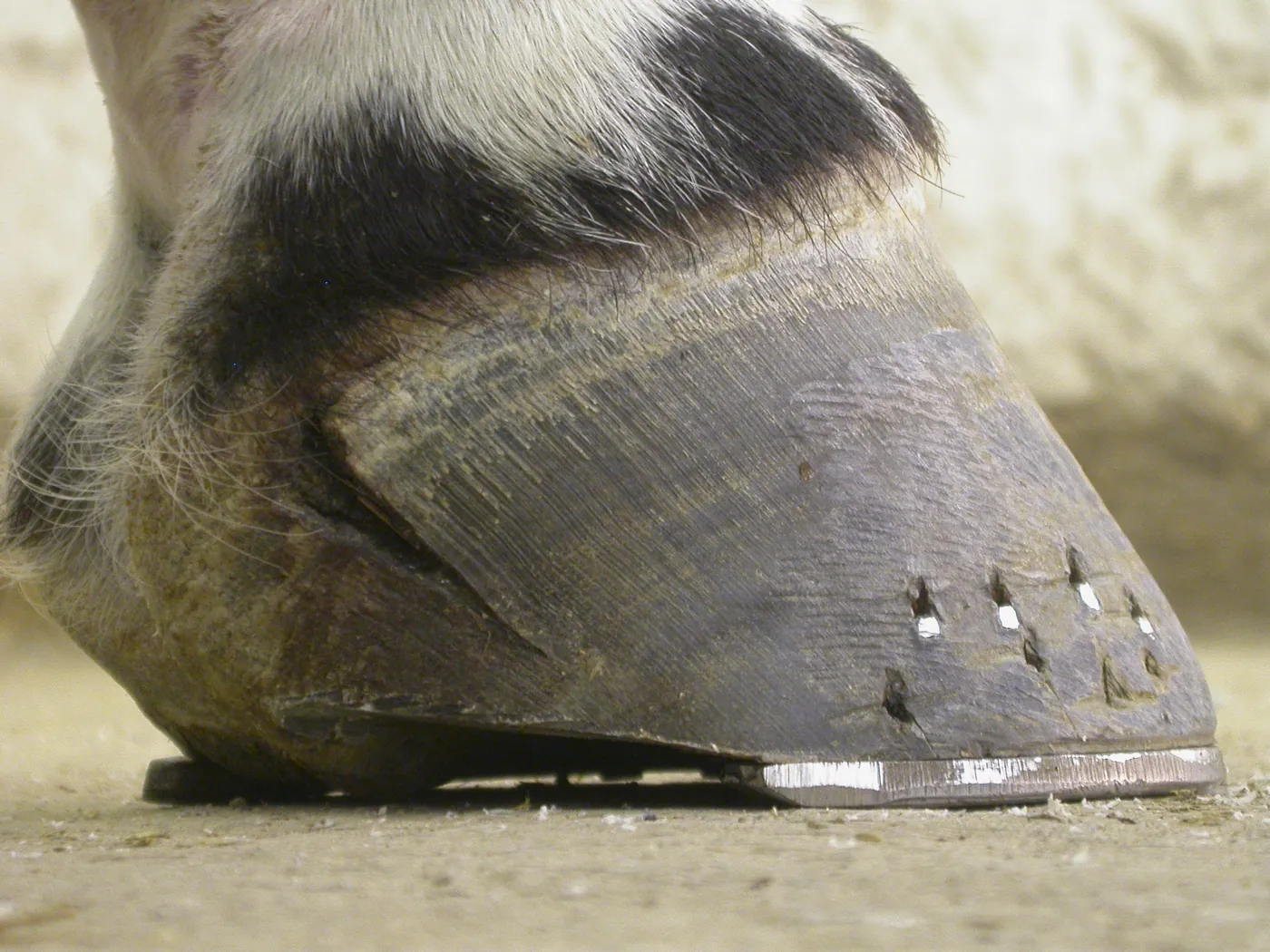
Photo: Uccio D’Agostino, CC BY 4.0, via Wikimedia Commons
- A long toe, or heels that look low or collapsed
- Flares, where the wall bends outward instead of growing straight down
- Cracks or splits in the wall
- Clinches (the bent-over nail ends on the wall) sticking up. They should feel smooth and barely noticeable under your hand.
- A shoe that feels loose or sounds different on hard ground
- The hoof spreading out over the edges of the shoe
- A lost shoe
Heat in a foot, a stronger pulse than usual at the fetlock or lameness is a different matter. Call your vet.
What happens at a trim or a reset
A good farrier starts by watching your horse stand and move.
At a trim, the farrier cleans out the foot, cuts the wall back to the right length with nippers, pares loose sole and ragged frog with a hoof knife and rasps the foot level. The goal is balance from side to side and front to back. Most horses need more toe taken off than heel.
A reset means reusing your horse’s existing shoes. The farrier straightens or cuts the clinches, pulls the shoes and trims as above. If the shoes have enough wear left, they are reshaped and nailed back on. If not, the horse gets new ones. The nail ends are bent over and rasped into neat clinches, about 3/4 inch up the wall and in a straight line.
What the farrier costs
Prices depend on your region, your horse and the work. The best national figures come from American Farriers Journal’s yearly survey of full-time farriers. In the 2026 survey:
| Service | National average | Regional range |
|---|---|---|
| Trim, 4 feet | $61 | $54 (central states) to $75 (far West) |
| Trim and set 4 keg shoes | $184 | $166 (central states) to $197 (far West) |
The 2025 survey put a trim and reset of 4 keg shoes at about $175, and a trim with 4 aluminum shoes at about $224. Some farriers charge the same for a reset as for new shoes; others charge less. Extras such as clips and bar shoes add to the bill, and many farriers add a barn call, mileage or fuel charge.
Treat these as a guide. The journal says its survey only reflects the farriers who choose to answer it. On a 6-week cycle, 8 or 9 visits a year at the 2026 averages comes to about $500 to $550 for trims, or about $1,500 to $1,650 for keg shoes, before trip fees.
University of Minnesota Extension’s advice: never choose a farrier on price alone. An experienced farrier can be expected to charge more.
How to keep a regular schedule
- Book the next visit before the farrier leaves. Utah State’s extension service advises giving your farrier plenty of lead time, and a date already in the calendar is hard to forget.
- Keep the routine in winter. Stretch the cycle only if your farrier agrees.
- Keep a record. For each visit, note the date, whether it was a trim, reset or new shoes, any pads or extras, what the farrier noticed and the cost. A photo of each foot after the visit makes changes easier to spot next time.
- Pick out the feet daily and check for the signs above.
Equiny can hold all of this. Log each visit with the work done, the farrier’s notes and the cost, set the cycle your farrier recommends, and Equiny reminds you before the next visit is due. You can share the record with your barn, too.
Working with your farrier
Good farriers are busy. Extension advice from Minnesota and Utah State on keeping one:
- Have the horse ready. Caught, brushed and clean before the farrier arrives, especially if several horses are booked.
- Provide a good place to work. Flat, clean and well lit. A rubber mat adds traction and comfort.
- Teach good manners. Practice tying and picking up all four feet. Never tolerate kicking, biting, leaning or pulling the leg away.
- Share what has changed. Tell your farrier about lameness, an abscess, a new diagnosis from your vet or a change in work.
- Pay promptly, understand how your farrier charges, and schedule and cancel in advance.
In the US no license or certificate is required to trim or shoe horses, so ask about training and experience, and ask your vet and other owners for referrals.
Hooves are one part of a horse’s routine. The horse care checklist puts the farrier alongside vaccines, deworming and dental care, and our guide to teeth floating covers the dental side.
Frequently asked questions
How often should a horse’s hooves be trimmed?
Most horses need a trim every 6 to 8 weeks, and 6 to 12 weeks may do in winter when growth slows. Barefoot horses in light work may go up to 10 to 12 weeks, while barefoot horses in regular work often need 5 to 7. Your farrier sets the cycle.
How often should horse shoes be reset?
Every 6 to 8 weeks for most shod horses. A shoe stops the hoof from wearing down, so the growth has to be trimmed off on schedule even when the shoes still look fine.
Can I wait longer between farrier visits in winter?
Often, yes. Hooves grow more slowly in cold weather, and extension services suggest 6 to 12 weeks in winter. Keep a routine anyway, and ask your farrier before stretching it.
How much does a farrier cost?
In American Farriers Journal’s 2026 survey of full-time farriers, a trim averaged $61 and a trim with 4 new keg shoes $184. The central states were cheapest and the far West most expensive. Trip fees and extras are often added.
Does nailing on shoes hurt the horse?
Done properly, no. The nails go through the outer hoof wall and must stay outside the white line, away from sensitive tissue. A nail driven into a sensitive area, called a hot nail, usually causes lameness, so call your farrier or vet if your horse is sore after shoeing.
Sources
- AAEP: Care Guidelines for Equine Rescue and Retirement Facilities, Basic Hoof Care (2019)
- University of Minnesota Extension: Caring for your horse’s hooves
- University of Minnesota Extension: Selecting a farrier for your horse
- Utah State University Extension: Proper basic hoof care
- University of Florida IFAS Extension: Hoof Care for Florida Horses, VM265 (2024)
- University of Kentucky: Horse hoof care 101 (2021)
- Extension Horses, University of Kentucky: How a horse’s hoof grows (2020)
- Moleman et al., Equine Veterinary Journal (2006): Hoof growth between two shoeing sessions
- US Equestrian: Hoof Sense, what are your horse’s hooves telling you? (2018)
- Karle et al., Veterinary World (2010): Horseshoeing, an overview
- American Farriers Journal: What farriers are charging for trimming and shoeing (2026)
- American Farriers Journal: Footcare and farrier business insights (2025 survey)
- American Farriers Journal: The nuts and bolts behind the Farrier Business Practices Survey (2026)
- American Farriers Journal: Price strategies for new and reset horseshoes (2019)
- Virginia Cooperative Extension: Equine hoof chat with a farrier (4-H activity)
This guide is general information, not veterinary advice. Ask your vet about your own horse.